
League of Legends Classic brings back older champions, items, Runes, Masteries, and map systems that many current players have never used. Even returning players may not remember how every Classic mechanic works.
This LoL Classic beginner guide explains the main differences, available modes, progression systems, and everything you should prepare before your first match.
Quick answer: LoL Classic combines an early version of Summoner’s Rift with 60 launch champions, older items, Runes, Masteries, and pre-rework champion kits. It also keeps modern features such as role preferences, updated matchmaking, modern pings, spell buffering, and optional WASD controls.
What Is League of Legends Classic?
League of Legends Classic is a separate gameplay experience built around the early years of League. It brings back older champions, items, mechanics, Runes, Masteries, and the classic Summoner’s Rift map.However, LoL Classic is not a perfect copy of one old patch. Riot used Season 3 as its main anchor but also included popular content from several early periods of League.
This means Classic includes a mixture of:
- Early Summoner’s Rift gameplay
- Pre-rework champion abilities
- Older items from several seasons
- Classic Summoner Spells, including Fortify
- Marks, Seals, Glyphs, and Quintessences
- Separate Mastery trees
- Slower combat and movement
- Selected modern technical improvements
Riot describes the mode as a collection of League’s early “greatest hits.” The goal is to recreate the strategy, experimentation, and memorable builds from older League without restoring every technical problem from that period.
Classic is separate from modern Summoner’s Rift. Progression, balance changes, Rune Pages, Summoner’s Journey ranks, and some cosmetic rewards belong specifically to the Classic experience.
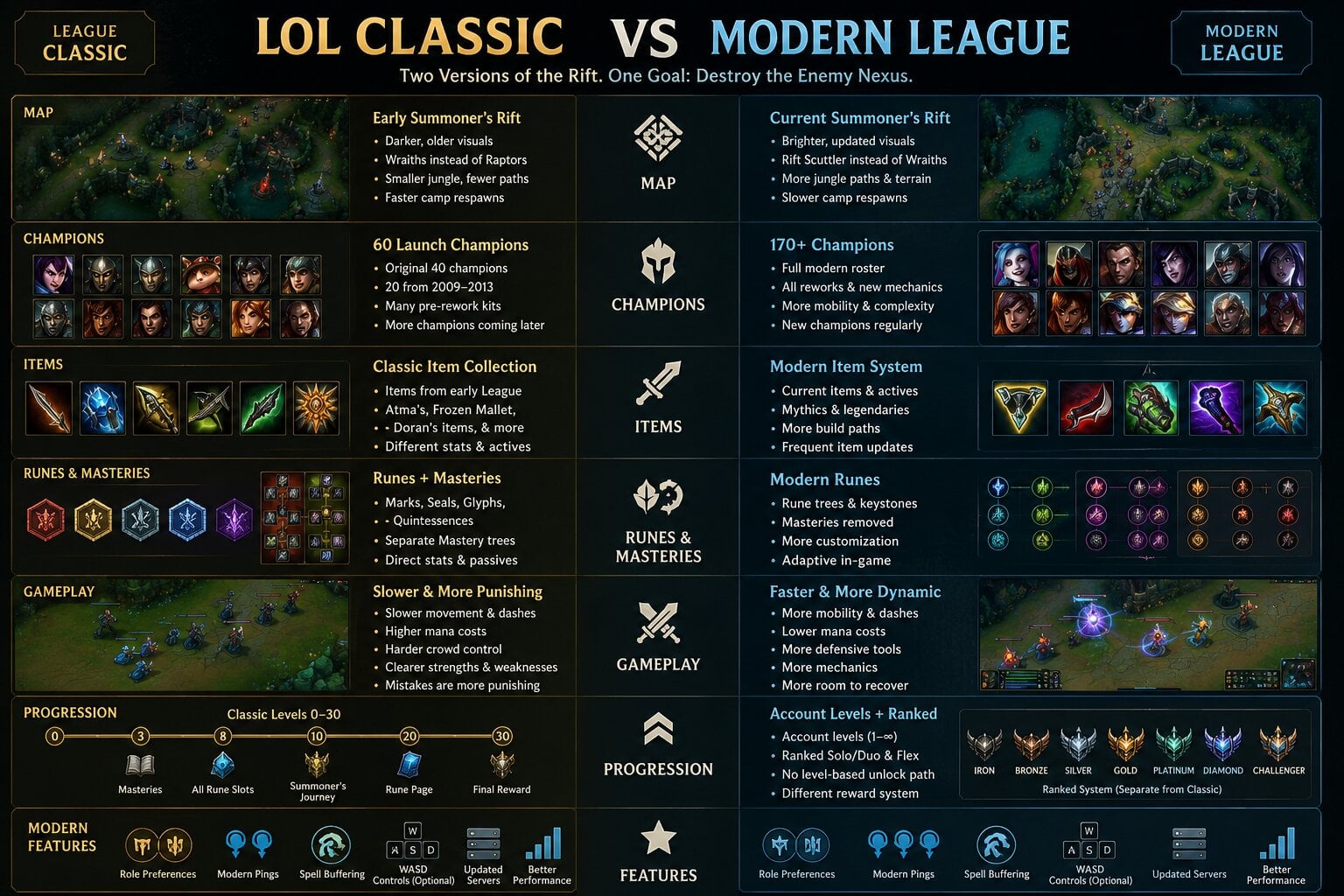
LoL Classic vs Modern League: Main Differences
LoL Classic uses the same basic goal as modern League. Two teams fight across Summoner’s Rift and try to destroy the enemy Nexus.The way players reach that goal feels different. Champions have clearer weaknesses, movement is slower, abilities can cost more mana, and individual spells may be more punishing.
| Feature | LoL Classic | Modern League |
|---|---|---|
| Main map | Early-style Summoner’s Rift | Current Summoner’s Rift |
| Champion roster | Focused roster of early-era champions | Full modern champion roster |
| Champion abilities | Many pre-rework kits | Current champion kits |
| Items | Items from League’s early years | Current item system |
| Runes | Marks, Seals, Glyphs, and Quintessences | Modern Rune trees |
| Masteries | Separate Mastery pages and trees | Replaced by the modern Rune system |
| Account progression | Classic Levels from 0 to 30 | Standard League account levels |
| Rank-style progression | Summoner’s Journey | Solo/Duo and Flex Ranked |
| Combat style | Slower movement with sharper strengths and weaknesses | More mobility and complex modern mechanics |
| Role selection | Roles ordered by preference | Primary and secondary position selection |
Fights Are Slower but More Punishing
Classic champions generally have less mobility. Missiles and dashes are slower, which makes positioning and planning more important.At the same time, individual abilities can deal heavy damage. Crowd control is common, and one poor position may lead to a long stun or a quick death.
Mana Management Matters More
Many Classic abilities have higher mana costs than their modern versions. Spamming spells without a clear reason can leave you unable to fight when an important moment begins.Health and Mana Potions also have more value. Buying sustain can be better than remaining in lane with no resources.
Champions Have Clearer Weaknesses
Modern champions often have several tools for movement, defence, damage, and recovery. Classic champions are more likely to be very strong in one area and weak in another.A champion with high damage may have no escape. A durable champion may struggle to reach mobile targets. Learning these limits is a major part of LoL Classic.
Which Game Modes Are Available in LoL Classic?
League Classic launches with one main PvP queue, Co-op vs AI, and custom games. Each mode serves a different purpose.PvP Draft
PvP Draft is the main matchmade player-versus-player mode. Both teams select champions through a draft before entering the match.Champion choices, role balance, and team composition matter. You may need to adjust your pick when the enemy team selects a strong counter or your team is missing damage, crowd control, or durability.
Co-op vs AI
Co-op vs AI places a team of players against computer-controlled opponents. It is a useful starting point when older champions, Runes, Masteries, and items feel unfamiliar.Use this mode to test ability ranges, practise a jungle route, and learn where items appear in the shop. League Classic also includes an introductory mission for completing a Co-op vs AI match.
Custom Games
Custom games allow organised players to create their own matches. They are useful for testing champion interactions, practising with friends, or checking how specific items and abilities work.Custom games may not provide the same progression or mission rewards as eligible matchmade games. Check the mission description before using a custom match for a progression goal.
How the LoL Classic Map Works
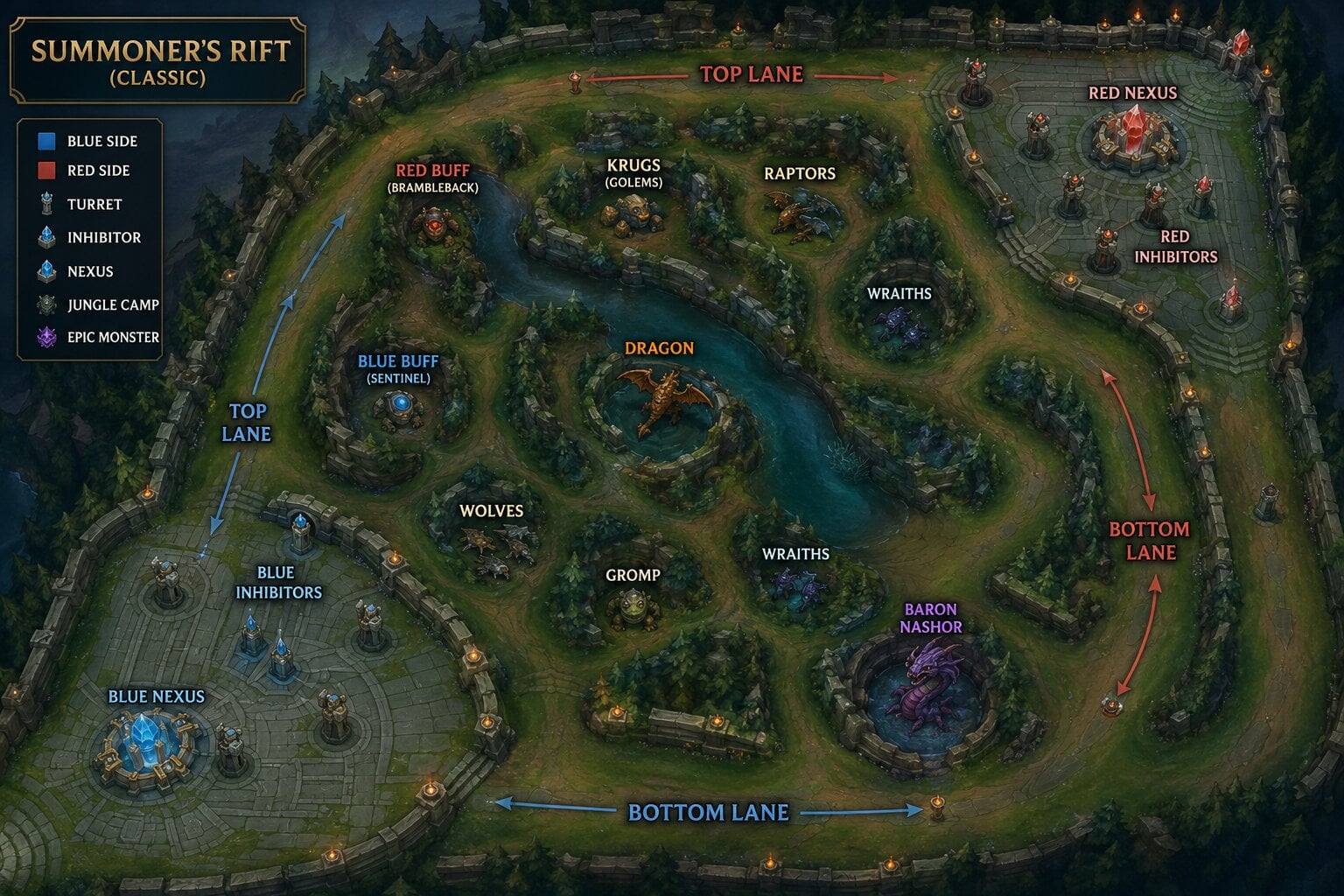
LoL Classic recreates the early Summoner’s Rift map. Riot improved its lighting, shadows, textures, and readability, but the layout and jungle systems are based on older League.Players familiar only with modern Summoner’s Rift will notice several changes.
- Wraiths replace the modern Raptor camp
- Red and Blue Buff monsters have smaller companions
- Jungle camps deal more damage
- Jungle camps respawn much faster
- Older terrain and visual structures return
- Early jungle sustain is more important
- Health Potions can be important for safe clears
Jungling Is More Dangerous Early
Classic jungle monsters can deal more damage than their modern versions. A weak first clear can force you to recall or leave you vulnerable to an enemy invade.Check your champion’s sustain before entering the jungle. Health Potions, defensive Runes, and a safer route may be needed.
Do not assume that a modern jungle route will work. Camp strength, spawn rules, champion abilities, and item choices can all be different.
Vision and Map Awareness Matter
Classic gameplay contains fewer escape tools. Being caught away from your team can be much harder to survive.Use wards around river entrances, objectives, and common jungle paths. Check the minimap before pushing too far into a lane.
Which Champions Are Available in LoL Classic?
LoL Classic begins with 60 champions. The roster includes the original 40 champions and another 20 selected from champions released between 2009 and 2013.Riot plans to add more early-era champions over time. Classic will not automatically include every champion available in modern League.
Many available champions use older versions of their abilities. A champion may look familiar while playing very differently from the version found in modern Summoner’s Rift.
Do You Need to Unlock Classic Champions?
Champions you already own are available in Classic immediately when they are part of the Classic roster. You do not need to purchase the same champion again.Unowned champions can be unlocked through Classic progression or acquired from the Shop. A free champion rotation is also available.
Should Beginners Play Their Modern Main?
Your modern main can be a good first choice, but only after you check the Classic ability descriptions. Older champion kits may have different damage, cooldowns, crowd control, ranges, and scaling.Before selecting a familiar champion, check:
- Every ability description
- Mana and energy costs
- Damage type and scaling
- Crowd-control duration
- Dash or escape availability
- Recommended Classic items
- Rune and Mastery requirements
A simple champion you understand is usually a better starting choice than a complex pick you have never played.
How LoL Classic Items Work
League Classic restores almost every item from the first few years of League. The item collection includes builds and effects that no longer exist in modern League.Examples include Atma’s Impaler, Frozen Mallet, older Gold-per-10 items, and many historical defensive, hybrid, and support options.
Classic does not copy one exact season’s item shop. Items from several early periods are combined to support memorable builds and new experiments.
Why Modern Champion Builds May Not Work
A current build guide may recommend items that do not exist in Classic. Even when an item has the same name, its stats or effects may be different.Champion ability ratios may also come from an older kit. A champion who currently builds attack damage may have supported an ability-power, tank, hybrid, or on-hit build in Classic.
Do not purchase an item only because you recognise its name. Read its full description in the Classic shop first.
How to Choose Your First Classic Build
Use this process when you do not know what to buy:- Check whether your champion deals physical, magic, or mixed damage
- Read the scaling shown on each ability
- Decide whether you need damage, defence, mana, or sustain
- Check the enemy team’s main damage types
- Buy early defence when your lane opponent is dangerous
- Read each item passive before completing the purchase
- Adjust the build instead of copying the same six items every game
Support Economy Is Different
Older support items and Gold-per-10 effects return in Classic. Support players may need to think more carefully about limited gold, vision costs, and efficient utility purchases.A low-cost item that helps the whole team may be more useful than saving for an expensive damage item.
How Runes Work in LoL Classic
Classic Runes provide direct stat bonuses before a match. They are separate from Masteries and use four categories: Marks, Seals, Glyphs, and Quintessences.| Rune Category | Common Purpose | Typical Uses |
|---|---|---|
| Marks | Offence | Attack damage, attack speed, and penetration |
| Seals | Defence and resources | Armour, health, and resource regeneration |
| Glyphs | Magic and utility | Magic resistance, ability power, and cooldown support |
| Quintessences | Large flexible bonuses | Damage, movement, defence, and utility |
Do You Need to Upgrade Classic Runes?
No. Riot uses the old Tier 3 Rune power as the starting standard. You do not need to purchase weaker Tier 1 and Tier 2 versions before accessing the strongest tier.Players unlock Rune categories by increasing their Classic Level. Default Rune pages are available before every custom category has been unlocked.
How Many Rune Pages Do You Receive?
Players begin with three Rune Pages. Another page unlocks at Classic Level 13, and one more unlocks at Level 20.Additional pages can be purchased with Influence Points. Separate pages are useful for physical damage, ability power, tank, jungle, and support setups.
For every Rune milestone and level reward, read our LoL Classic Unlocks Guide.
How Masteries Work in LoL Classic
Masteries are passive bonuses selected before entering a match. They use a separate tree-based system rather than being included inside a modern Rune page.Different Mastery choices can improve damage, defence, sustain, resource use, and utility. Your selected setup should match the champion and role you plan to play.
| System | Main Effect | How It Is Configured |
|---|---|---|
| Runes | Direct stat bonuses | Rune categories, slots, and pages |
| Masteries | Passive bonuses and effects | Mastery points placed into trees |
Custom Masteries unlock at Classic Level 3. Riot also provides default pages, so forgetting to create a setup will not leave you without any bonuses.
A default page may still be weaker than a setup designed for your exact champion. Prepare your pages before placements or important progression matches.
How LoL Classic Levels Work
Every player begins at Classic Level 0. The maximum Classic Level is 30, and this progression is separate from your normal League account level.Classic XP is earned by playing Classic matches and completing eligible missions. Levels unlock gameplay systems, currencies, features, and cosmetic rewards.
| Classic Level | Main Unlock | Why It Matters |
|---|---|---|
| Level 3 | Masteries | Allows custom Mastery pages |
| Level 4 | Mark Rune Slots | Begins custom Rune progression |
| Level 5 | Council Voting Power | Unlocks your first Council vote |
| Level 6 | Seal Rune Slots | Adds another Rune category |
| Level 7 | Glyph Rune Slots | Expands Rune customisation |
| Level 8 | Quintessence Slots | Unlocks all four Rune categories |
| Level 10 | Summoner’s Journey | Unlocks placements and Journey progression |
| Level 13 | Additional Rune Page | Adds another saved Rune setup |
| Level 20 | Additional Rune Page | Adds another saved Rune setup |
| Level 30 | Final Classic Level Reward | Completes the permanent level track |
For the full XP curve, mission rewards, and estimated time to Level 30, read our LoL Classic Leveling Guide.
Players who want to reach an important milestone faster can use our LoL Classic Level Boost and select their current and target level.
What Is Summoner’s Journey?
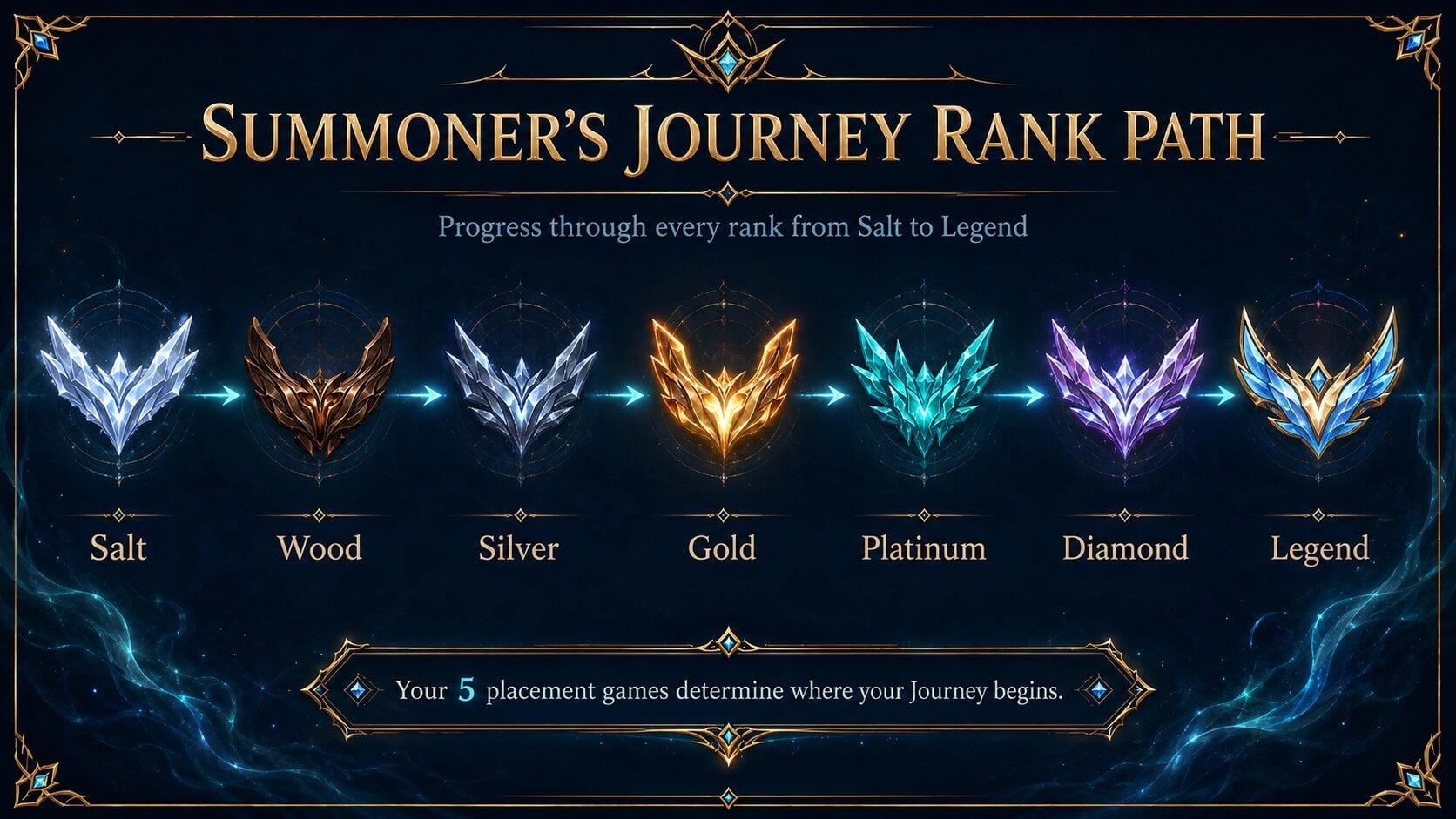
Summoner’s Journey is League Classic’s rank-style progression system. It unlocks at Classic Level 10.After unlocking the system, you complete five placement games. Those matches determine your first Journey Emblem and division, so not every player automatically begins at Salt.
The main Summoner’s Journey ranks are:
Salt → Wood → Silver → Gold → Platinum → Diamond → Legend
Most Emblems contain Divisions IV through I. Summoner Points, commonly shortened to SP, control your Journey progress after placements.Summoner’s Journey is separate from modern Solo/Duo Ranked. Legend is the highest Journey Emblem, but it is not the same rank as Challenger.
For a complete explanation, read our LoL Classic Summoner’s Journey Guide.
Players can also use our LoL Classic Placement Boosting or Summoner’s Journey Boost for professional assistance.
How Role Selection Works in LoL Classic
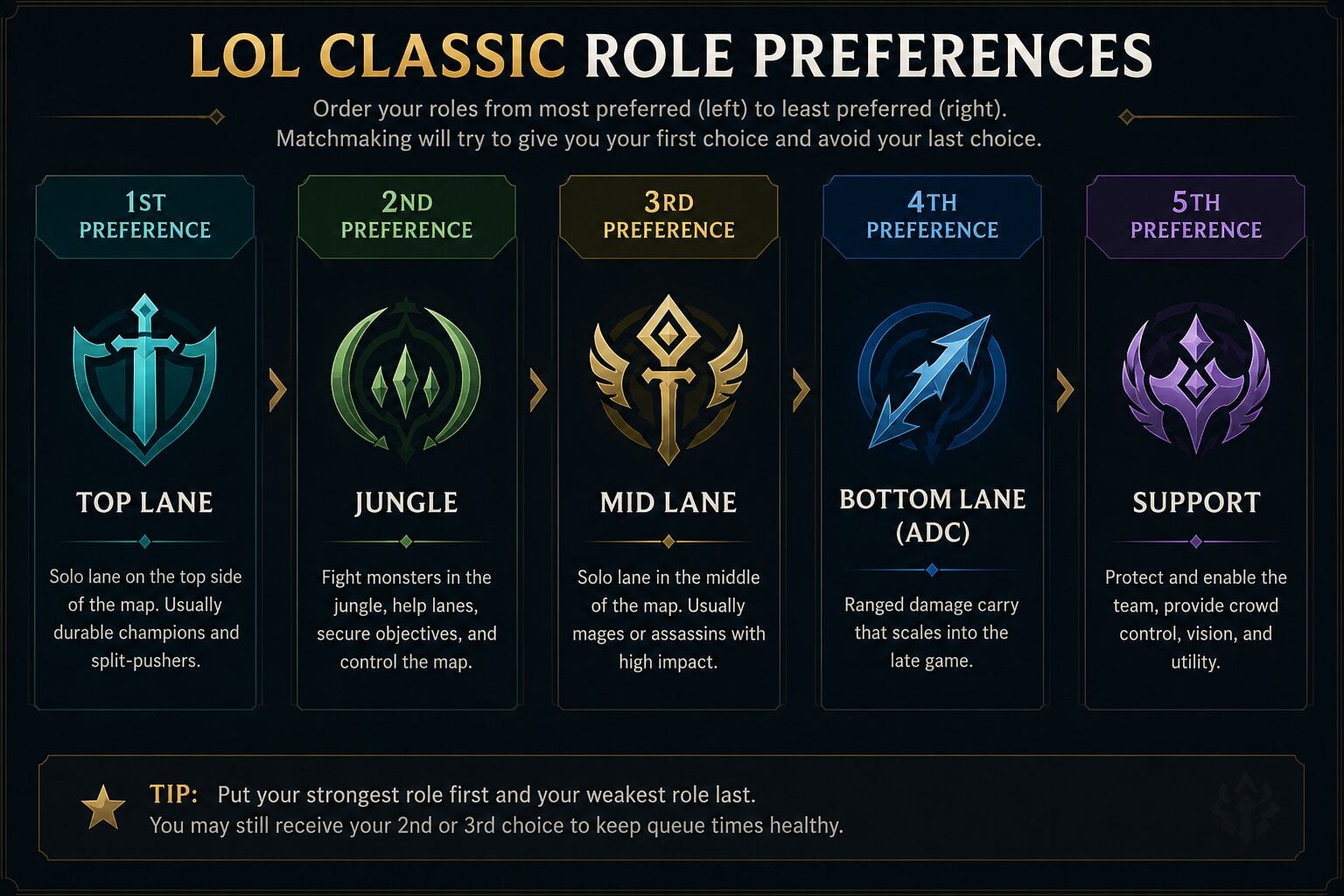
LoL Classic does not bring back the old system where players had to type their preferred role into chat before anyone else.Instead, you order all roles by preference. Matchmaking tries to assign your first choice and avoid your final choice when possible.
You may still receive your second or third choice to keep queue times reasonable.
How to Order Your Role Preferences
Use this approach before joining the queue:- Place your strongest role first
- Place your second-best role second
- Prepare at least one champion for your third choice
- Place your weakest role last
- Create Rune and Mastery pages for your likely roles
Do not prepare for only one position. Even when your first choice is popular, the system cannot guarantee it in every match.
Does LoL Classic Support WASD?
Yes. Optional WASD controls are available in LoL Classic.Players who prefer traditional mouse movement can continue using it. You do not need to change your controls to enter Classic.
What to Do Before Your First LoL Classic Match
A few minutes of preparation can prevent major mistakes. Use this checklist before entering your first PvP match.First LoL Classic Match Checklist
- Check whether your champion uses an older ability kit
- Read every ability and passive
- Choose suitable Summoner Spells
- Prepare or review your Rune Page
- Prepare or review your Mastery Page
- Read the available Classic items
- Order your role preferences
- Consider playing Co-op vs AI first
- Complete available introductory missions
- Check your Classic XP after the match
Check Your Champion Before Queueing
Do not wait until champion select to discover that your main uses an older kit. Read the abilities in advance and identify any missing dash, shield, passive, or modern mechanic.Prepare Runes and Masteries
Default pages are available, but they may not match your champion or lane. A custom setup can improve your early damage, defence, sustain, or resource management.Review the Item Shop
Open a custom or Co-op game and inspect the shop. Finding the correct items during a live PvP match can waste time and delay important purchases.Best LoL Classic Tips for Beginners
1. Manage Your Mana Carefully
Classic abilities can cost more mana. Avoid using spells only to deal a small amount of damage when you may need those resources for a fight or escape.Watch both your own mana and the enemy’s mana. A lane opponent with no resources may be unable to trade or defend against a gank.
2. Respect Crowd Control
Classic contains many direct stuns and other strong crowd-control effects. Entering the wrong range may leave you unable to react.Track important enemy abilities before starting a fight. Wait for a dangerous stun or silence to be used when possible.
3. Buy Sustain When You Need It
Health and Mana Potions can keep you in lane or help you survive an early jungle clear. Do not avoid sustain only because it delays another item by a small amount.A safe recall with enough gold is better than dying while trying to save for a larger purchase.
4. Do Not Assume Every Modern Mechanic Exists
A modern champion passive, item effect, jungle rule, or map feature may not exist in Classic. Check the actual Classic description instead of relying on memory.5. Use Simple Champions First
Start with champions that have clear abilities and simple goals. You can learn more complex picks after understanding the map, items, Runes, and combat speed.6. Prepare Before Champion Select
Know which champions you can play in your first three role preferences. Prepare basic Rune and Mastery pages before entering the queue.7. Learn One Main Role
Focus on one main role and one backup role. Learning all five roles at once makes it harder to understand matchups, builds, and map decisions.8. Play With a Reliable Duo
A dependable teammate can help with communication, lane coordination, objectives, and unfamiliar Classic systems.Choose roles that naturally work together, such as bottom and support or jungle and mid.
Common LoL Classic Beginner Mistakes
| Beginner Mistake | Why It Causes Problems | Better Approach |
|---|---|---|
| Copying a modern build | Classic items and champion ratios can be different | Read Classic item and ability descriptions |
| Ignoring Rune Pages | Direct stat bonuses can affect early lanes | Prepare a page for your champion and matchup |
| Forgetting Masteries | The default setup may not fit your role | Create a suitable Mastery page before queueing |
| Spamming abilities | Higher mana costs can leave you without resources | Use spells with a clear purpose |
| Entering placements immediately | Unfamiliar systems may hurt your starting position | Practise champions and builds first |
| Learning every role at once | Progress and matchup knowledge become slower | Focus on one main role and one backup |
| Assuming everyone starts at Salt | Placements determine the first Emblem and division | Take all five placement games seriously |
| Ignoring early level milestones | Levels 3, 8, and 10 unlock major systems | Choose a target based on the feature you need |
Which LoL Classic Progression Goal Should You Choose?
You do not need to reach Level 30 before enjoying League Classic. The best goal depends on which features and services you need.Reach Level 8 for Every Rune Category
Level 8 unlocks Quintessence slots, completing the four main Rune categories. This is a useful early target for players who want full Rune customisation.Use our LoL Classic Level Boost to select Level 8 or another target milestone.
Reach Level 10 for Summoner’s Journey
Summoner’s Journey unlocks at Level 10. Choose this target when you want to begin your five placement games and receive a Journey Emblem.Complete Five Placement Games
Placements determine your first Summoner’s Journey Emblem and division. Strong results can lead to a higher starting position, but there is no guaranteed public placement table.Our LoL Classic Placement Boosting service supports account-shared and Duo options.
Climb Summoner’s Journey
Players who already have an assigned Emblem can continue through Salt, Wood, Silver, Gold, Platinum, Diamond, and Legend.Use our LoL Classic Summoner’s Journey Boost to choose your current and target position.
Complete Normal Games
Some players want to practise, progress, or complete a chosen number of unranked Classic matches without targeting a Journey rank.Our LoL Classic Normal Games Boost supports orders based on completed games or wins.
Can LoL Classic Boosting Help New Players?
LoL Classic boosting can help players who do not have time to complete every progression step manually. The correct service depends on your current goal.Available services can help with:
- Classic Level progression
- Unlocking Runes and Masteries
- Reaching Classic Level 10
- Completing five placement games
- Summoner’s Journey progression
- Normal Classic games and wins
Piloted boosting lets a professional booster complete the selected progress on the account. Duo boosting allows you to play with an experienced booster while keeping control of the account.
Orders are completed through normal League Classic gameplay. Boosters do not use bots, scripts, cheats, or progression exploits.
Start Your LoL Classic Journey
Choose the service that matches your goal, from Classic Levels and placements to normal games and Summoner’s Journey progression.
Level Boost
Placement Boost
Division Boost
Normal Games
LoL Classic Beginner FAQ
What is LoL Classic?
LoL Classic is a separate League experience based on the game’s early years. It uses an early Summoner’s Rift map, older champions, items, Runes, Masteries, and gameplay systems.Is LoL Classic a copy of Season 3?
No. Season 3 is the main anchor, but Riot included popular champions, items, Summoner Spells, and mechanics from several early League periods.How many champions are available in LoL Classic?
LoL Classic launches with 60 champions. The roster includes the original 40 champions and another 20 selected from champions released between 2009 and 2013.Will more champions be added?
Yes. Riot plans to add more champions from League’s early years. Classic will not include every modern champion.Does LoL Classic use old champion abilities?
Many champions use pre-rework ability kits. Always check the Classic ability descriptions before relying on your knowledge of the modern version.Does LoL Classic have Ranked?
LoL Classic does not use the normal modern Ranked ladder. It has a separate rank-style progression system called Summoner’s Journey.What is Summoner’s Journey?
Summoner’s Journey is a Classic progression system that uses placement games, Emblems, divisions, and Summoner Points.What level unlocks Summoner’s Journey?
Summoner’s Journey unlocks at Classic Level 10. Reaching Level 10 requires progress through the separate Classic Level system.Does LoL Classic have placement games?
Yes. You complete five placement games after unlocking Summoner’s Journey. The results determine your first Emblem and division.Does every player begin at Salt?
No. Salt is the lowest Journey Emblem, but your five placement games can assign a higher starting position.How do LoL Classic Runes work?
Classic Runes provide direct stat bonuses through Marks, Seals, Glyphs, and Quintessences. Rune categories and additional pages unlock through Classic Levels.Do you need to upgrade Classic Runes?
No. Classic Runes use old Tier 3 strength as the baseline, so players do not need to purchase weaker versions first.How do LoL Classic Masteries work?
Masteries provide passive bonuses through separate tree-based pages. They are selected alongside Runes before entering a match.Can you use modern skins in LoL Classic?
Many existing skins are available in Classic, although not every skin may be ready immediately. Classic Skins replace the modern base appearance for eligible champions and are specific to Classic.Does LoL Classic support WASD controls?
Yes. WASD movement is available as an optional control method. Traditional mouse movement is still supported.Can you play LoL Classic against bots?
Yes. Co-op vs AI is available alongside PvP Draft and custom games.Do LoL Classic Levels reset?
No. Classic Levels are a permanent, one-time account progression system. Seasonal Classic Passes are separate.What should a beginner do first?
Read your champion’s Classic abilities, prepare Runes and Masteries, review the item shop, and consider playing Co-op vs AI before entering serious PvP matches or placements.Final Summary
LoL Classic combines the map, champions, items, Runes, Masteries, and combat style of early League with selected modern technical improvements.The game launches with 60 champions, PvP Draft, Co-op vs AI, and custom games. Many champions use pre-rework abilities, so modern builds and strategies may not work.
Players begin at Classic Level 0 and unlock major systems as they progress. Masteries unlock at Level 3, all Rune categories are available by Level 8, and Summoner’s Journey unlocks at Level 10.
Before your first match, check your champion kit, prepare your Rune and Mastery pages, review the Classic item shop, and order your role preferences.
Players who want help with levels, placements, normal games, or Journey progression can choose the matching LoL Classic boosting service from Boosting Factory.

Grandmaster
Secure your LoL seasonal rewards, today.