
Overwatch Team Drives are limited-time Competitive events built around Fame, Gladiator Ranks, auto-grouping, and a final challenge called The Trial. Blizzard introduced Team Drives as an experimental format, then brought them back with the same core idea: win, keep a strong team together, and progress faster as a group.
This guide explains how Team Drives work, their rewards, Fame, Gladiator Ranks, the heart icon, The Trial, and how they differ from regular Overwatch Competitive Drives. Exact Fame thresholds and some reward values can change between Team Drives, so first-event numbers are clearly labeled where relevant.
Overwatch Team Drives at a Glance
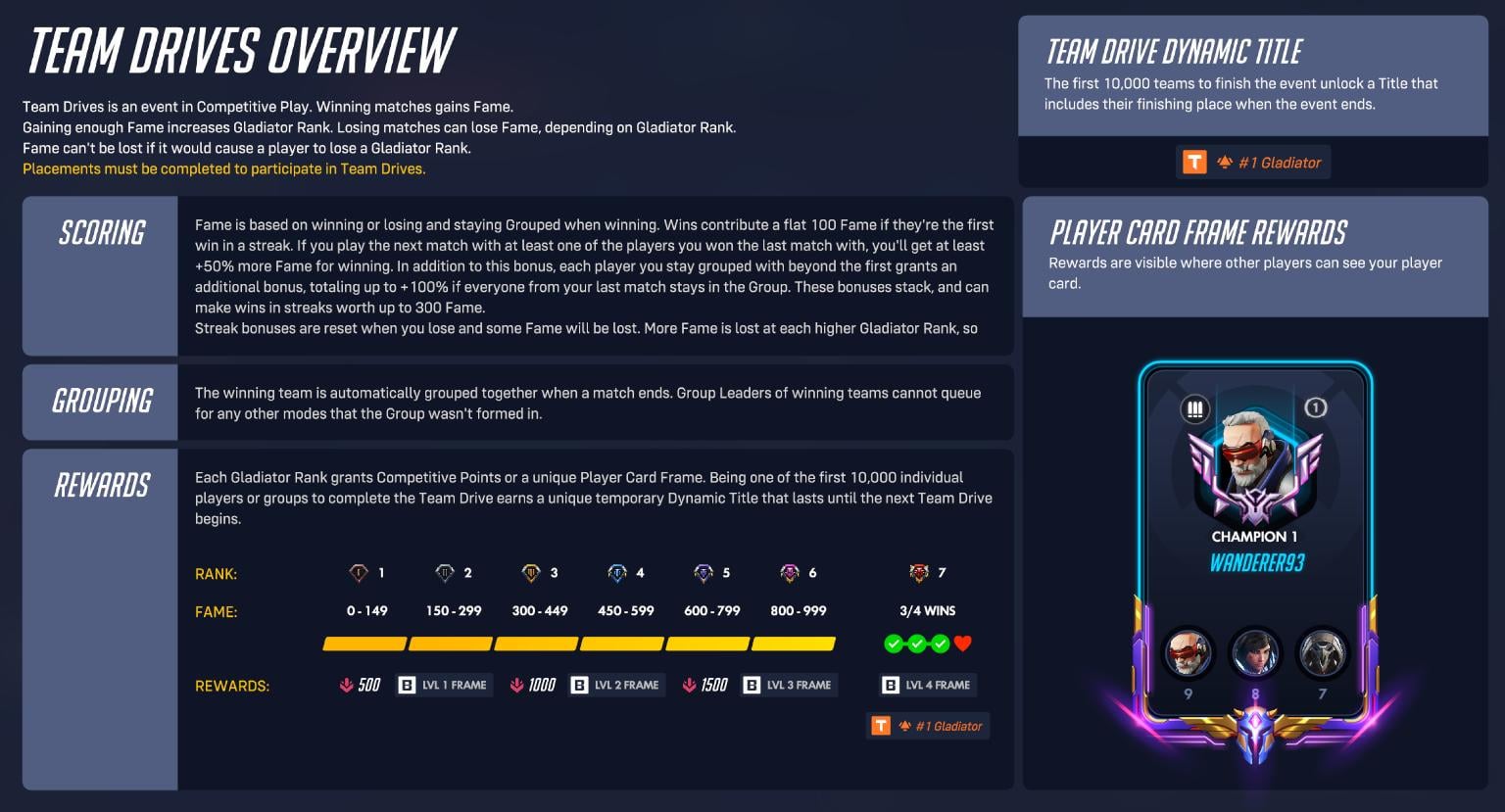
Team Drives change the normal Drive formula by rewarding players for winning together. You can queue solo or with friends, and after a win, matched teammates can automatically stay grouped for the next match. Keeping a successful team together speeds up progression through Gladiator Ranks.Blizzard originally introduced the format as experimental, but Team Drives have since returned as a repeat limited-time Competitive event. Competitive placements, auto-grouping after wins, Gladiator Ranks, Hero Bans, Map Voting, Competitive Points, Player Card Frames, and the final Trial remain part of the format. The original system details are documented in the official Overwatch patch notes.
| Feature | Team Drives |
|---|---|
| Event Type | Limited-time Competitive event |
| Availability | Runs during selected limited-time Competitive windows |
| Progress | Fame |
| Progress Tiers | Gladiator Ranks |
| Prerequisite | Complete Competitive placements |
| Main Mechanic | Stay grouped with winning teammates for larger Fame gains |
| First-Event Base Win | 100 Fame |
| First-Event Maximum Win | Up to 300 Fame with grouped streak bonuses |
| Losses | Can remove Fame and reset streak bonuses, but reached Gladiator Ranks are protected |
| Final Stage | The Trial |
| Main Rewards | Competitive Points, Player Card Frames, and event-specific Dynamic Title rewards |
| Solo Play | Allowed, but grouping provides faster progression |
| Premade Groups | Allowed |
| Competitive Systems | Normal Competitive rules such as Hero Bans and Map Voting still apply |
Do You Need Competitive Placements for Team Drives?
Yes. Blizzard requires you to complete your Competitive placements before participating in Team Drives. Your normal Competitive Skill Rank remains separate from your Team Drive Gladiator Rank.Placement matches do not replace Team Drive progression. If a Team Drive is available, finish your placements first so you can start earning Team Drive progress immediately.
How Do Overwatch Team Drives Work?
Team Drives add a team-building system around normal Competitive matches. Winning matters on its own, but the format gives extra progression value to players who stay with successful teammates.The core Team Drive loop works like this:
- Complete your Competitive placements before participating.
- Win a Competitive match to begin building Fame.
- Stay grouped with winning teammates after the match.
- Win again with members of the previous winning team to earn additional Fame bonuses.
- Keep successful groups together to build larger progression bonuses.
- Earn Fame and progress through Gladiator Ranks.
- Reach the final Gladiator Rank and enter The Trial.
- Pass The Trial using the completion requirement shown for the active event.
Team Drives do not replace the normal rules of Competitive Play. Systems such as Hero Bans and Map Voting still operate during eligible matches, while Fame and Gladiator Ranks track your event progress separately.
What Happens After You Win?
After a Team Drive win, matched teammates can automatically remain grouped for the next queue when Team Drive auto-grouping is enabled. The purpose is to encourage successful teams to keep playing together rather than immediately returning everyone to separate queues.During the first Team Drive, a first win in a streak awarded 100 Fame. Winning another match with at least one player from the previous victory added at least a +50% Fame bonus, while keeping more members of the winning team together could increase the bonus further.
Successful grouped streaks could eventually make a win worth up to 300 Fame. These exact Fame values came from the first Team Drive and can be adjusted if Blizzard changes the system in a future event.
What Happens If You Leave the Team?
You are not permanently locked into a Team Drive group. You can leave and return to solo queue whenever you want.Blizzard says your individual bonus is preserved, but you stop benefiting from the bonuses contributed by the successful teammates you left behind. You can also enter a Team Drive with your own friends instead of relying on automatic groups.
OVERWATCH TEAM DRIVES BOOSTING
Complete Team Drives Faster
Get help earning Fame, climbing Gladiator Ranks, unlocking Team Drive rewards, and completing The Trial.
Get Overwatch Drives Boosting
What Is Fame in Overwatch Team Drives?
Fame is the progression score used during Team Drives. It fills a similar role to Drive Score in standard Competitive Drives, but Team Drives place much more emphasis on consecutive wins with the same teammates.Fame determines your progress through Gladiator Ranks before you reach the final Trial stage.
How Much Fame Do You Get Per Win?
The first Team Drive used the following Fame system:- First win in a streak: 100 Fame.
- Keep at least one teammate from the previous win: another victory received at least +50% additional Fame.
- Keep more winning teammates together: additional group bonuses increased the reward.
- Keep the full successful team together: the group bonus could become significantly larger.
- Build a grouped winning streak: a victory could eventually be worth up to 300 Fame.
This means even a duo can benefit from the Team Drive system. You do not necessarily need a full stack to gain more Fame because keeping just one successful teammate can already improve progression.
The exact Fame numbers are easier for Blizzard to tune than the core Team Drive system, so future events may use different values while keeping the same group-focused concept.
Do You Lose Fame After a Loss?
Yes. Losses can remove Fame and break your streak bonus. During the first Team Drive, Fame losses became more punishing as players moved higher through the Gladiator track.However, Gladiator Ranks act as protected milestones. A Fame loss cannot push you below a Gladiator Rank you have already reached.
This makes reaching the next rank important. You can lose progress inside your current stage, but completed Gladiator Ranks protect you from falling all the way back down the track.
All Overwatch Team Drive Gladiator Ranks and Rewards
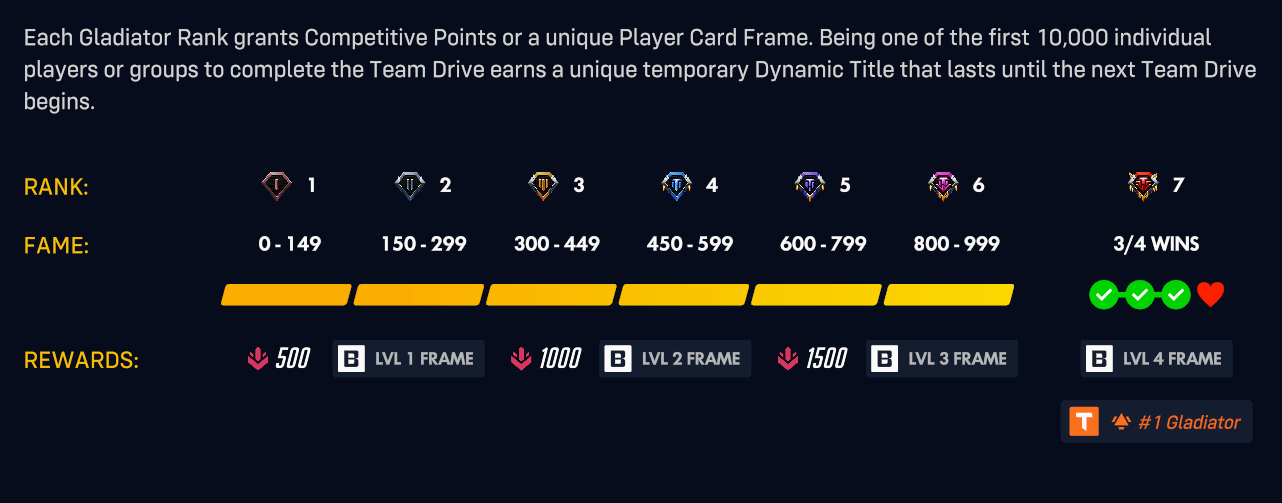
Gladiator Ranks are the progression milestones used by Team Drives. They are completely separate from your normal Competitive Skill Rank and do not replace Bronze, Silver, Gold, Platinum, Emerald, Diamond, Master, Grandmaster, or Champion.
The first Team Drive used six Fame-based Gladiator Ranks followed by Rank 7, The Trial. Its reward track is shown below.
Future Team Drives may change Fame thresholds, Competitive Point amounts, or cosmetic rewards, so the table should be treated as the structure and rewards used for the first Team Drive rather than a guarantee for every future event.
| Gladiator Rank | First Team Drive Requirement | First Team Drive Reward |
|---|---|---|
| Rank 1 | 0-149 Fame | 500 Competitive Points |
| Rank 2 | 150-299 Fame | Level 1 Player Card Frame |
| Rank 3 | 300-449 Fame | 1,000 Competitive Points |
| Rank 4 | 450-599 Fame | Level 2 Player Card Frame |
| Rank 5 | 600-799 Fame | 1,500 Competitive Points |
| Rank 6 | 800-999 Fame | Level 3 Player Card Frame |
| Rank 7 | The Trial: win 3 of your last 4 matches | Level 4 Player Card Frame + numbered Title for eligible first-event finishers |
The first Team Drive's Fame portion ended once players cleared the 0-999 Fame track. After that, collecting more Fame was not enough to finish the event. Full completion required passing The Trial.
Overwatch Team Drive Rewards
Team Drives use their own reward structure instead of simply copying standard Competitive Drives. Competitive Points and Player Card Frames are recurring Team Drive rewards, while Blizzard can also attach a Dynamic Title to the final Trial race.The first Team Drive offered up to 3,000 Competitive Points. Exact Competitive Point totals, Fame thresholds, and other rewards can change between events.
Competitive Points
The first Team Drive split 3,000 Competitive Points across three Gladiator Ranks:- Rank 1: 500 Competitive Points
- Rank 3: 1,000 Competitive Points
- Rank 5: 1,500 Competitive Points
That added up to 3,000 Competitive Points for reaching all three CP reward stages.
Future Team Drives can use different reward amounts, but Competitive Points are part of Blizzard's intended reward structure for the event format.
Player Card Frames
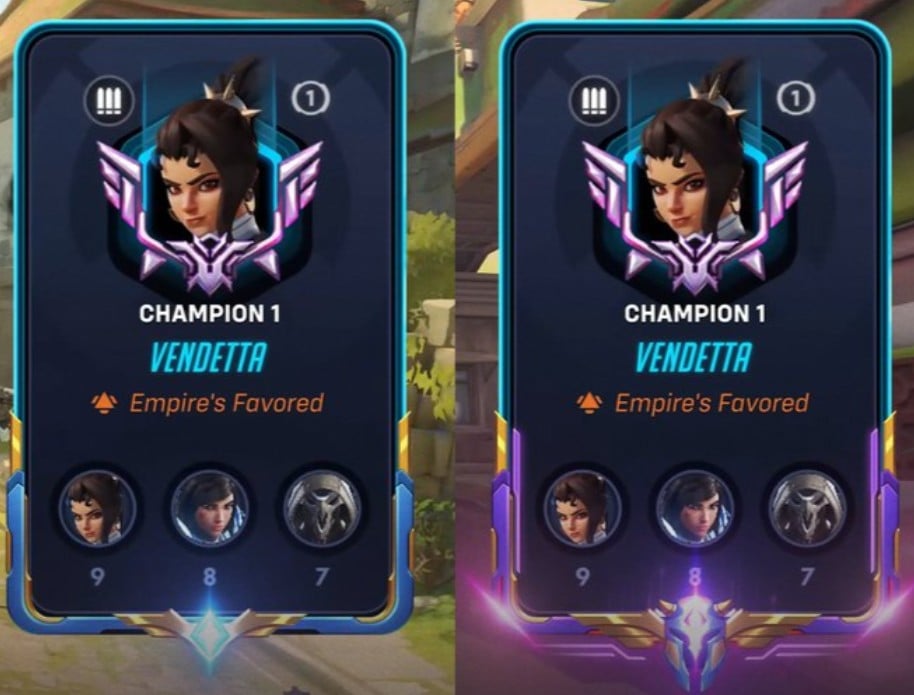
Team Drives use Player Card Frames instead of the Signatures used by regular Competitive Drives. These frames appear around your Player Card wherever the card is displayed.In the first Team Drive, the Player Card Frame improved through four levels at Gladiator Ranks 2, 4, 6, and 7. Blizzard has continued to list Player Card Frames as a Team Drive reward, although the exact reward track can change.
Dynamic Gladiator Title
Blizzard also uses a Dynamic Title as a race reward for the fastest Team Drive finishers. In the returning format, Blizzard has awarded it to the first 10,000 groups to finish the final Trial.Because this reward is tied to completion order, it is different from the normal Gladiator Rank rewards. If you care about the Dynamic Title, reaching and finishing The Trial early matters much more than simply completing the event before it ends.
Blizzard can change limited-race rewards between Team Drives, so always check the active reward track before assuming the same Title rules will apply forever.
What Is The Trial in Overwatch Team Drives?
The Trial is the final completion stage of Team Drives. Reaching the end of the Fame track does not automatically mean the Team Drive is finished.In the first Team Drive, passing The Trial required winning 3 of your last 4 Competitive matches. This made the final stage a test of recent results rather than another Fame grind. Blizzard can tune the exact Trial condition between events, so check the active requirement in-game.
| Last 4 Matches | Result |
|---|---|
| W – W – L – W | ✅ Pass |
| W – L – W – W | ✅ Pass |
| L – W – W – W | ✅ Pass |
| W – L – W – L | ❌ Not Passed |
| L – W – L – W | ❌ Not Passed |
This makes the final Team Drive stage different from a normal progression grind. You need an actual winning stretch to complete it.
Is It Called The Trial or The Trail?
Blizzard's original Team Drive patch notes used both spellings. One part referred to the final stage as "The Trail," while another called it "The Trial."The in-game event and player discussions commonly use The Trial, so that is the wording used throughout this guide.
How Do I Get the Heart in Overwatch Team Drives?
You do not unlock the heart as a separate reward. In the first Team Drive, the heart shown at Gladiator Rank 7 represented the one-loss buffer built into The Trial.That Trial required 3 wins in your last 4 matches, so one loss could still fit inside a successful four-match window.
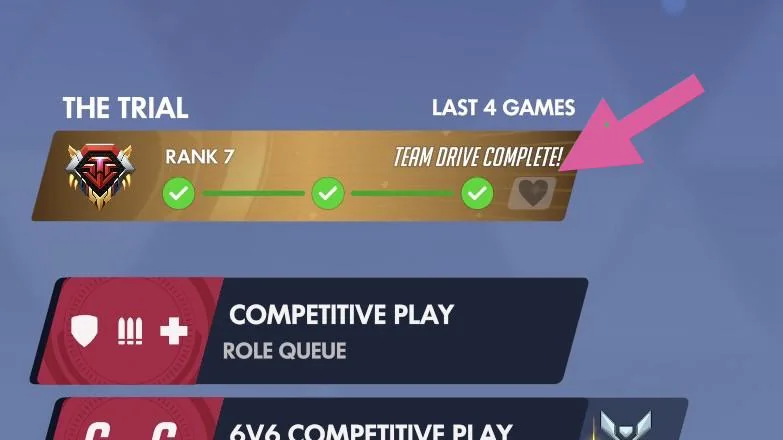
If you lose once during The Trial, the heart can appear grey or empty. That does not mean you missed a separate reward.
For example, W – L – W – W still completes The Trial. The player used the allowed loss but finished with three wins in the latest four matches.
Do You Need the Heart Filled to Complete Team Drives?
No. The heart is not an additional reward or completion objective.If your Team Drive shows as completed even though the heart is empty, you have still met the requirement. The heart is a visual indicator related to the one loss allowed within the 3-of-4 Trial condition.
Do You Have to Lose a Game to Get the Heart?
No. Do not intentionally lose a match. You do not need to activate or earn the heart.If you win the required matches without losing, you can complete The Trial without using that buffer at all.
What Happens If You Lose Twice During The Trial?
Under the first Team Drive rules, two losses meant your latest results no longer contained the required 3 wins out of 4.You had to continue playing until your most recent four eligible Competitive matches contained at least three wins. If Blizzard changes the Trial rules for a later event, follow the requirement shown in-game instead.
Can You Play Overwatch Team Drives Solo?
Yes. Team Drives can be played solo. You do not need to enter with a premade group.However, the system is designed to reward grouping. After a win, matched teammates can automatically stay together, allowing later wins to benefit from stronger Team Drive progression.
A player who repeatedly returns to solo queue can still progress, but will usually give up some of the main progression advantage Team Drives are built around.
Can You Bring a Full Stack?
Yes. Blizzard allows players to enter Team Drives with their own friends or a premade group instead of relying entirely on automatic grouping.A premade group gives you more control because good random teammates cannot simply leave after every match. You do not need a full stack to benefit, though. Even keeping one reliable teammate can help you preserve grouped progression bonuses.
How to Disable Team Drive Auto-Grouping
If you do not want Overwatch to automatically group you after Team Drive wins, you can turn the feature off.Go to:
Social → General → Groups → Enable Auto-Grouping on Team Drive Wins
Turn the setting Off. You can still participate in Team Drives, but Blizzard warns that completing the event can be harder when you do not benefit from successful teammates as often.
Does Stadium Count for Overwatch Team Drives?
Stadium did not count toward the first Team Drive. Players had to use eligible regular Competitive queues instead.This is worth separating from standard Competitive Drives because recent normal Drives have allowed Stadium progression. Team Drives are their own event format and Blizzard can set different eligibility rules for them.
Future Team Drives could use different eligible queues, so check the current event interface before assuming Stadium will always be included or excluded.
Does Open Queue Count for Team Drives?
Blizzard did not publish a complete mode-by-mode eligibility table for the first Team Drive.If a future Team Drive is available while you are using Open Queue or another Competitive format, make sure you have completed the required placements and confirm that Team Drive progression appears for that queue before relying on it.
Team Drives vs Competitive Drives
Team Drives and standard Overwatch Competitive Drives are both limited Competitive events, but they use different progression and completion systems.| Feature | Team Drives | Competitive Drives |
|---|---|---|
| Progress System | Fame | Drive Score |
| Progress Tiers | Gladiator Ranks | Checkpoints |
| Auto-Grouping | Yes, after wins when enabled | No equivalent system |
| Group Progress | Successful grouped streaks increase Fame gains | Uses normal Drive group bonus rules |
| Loss Protection | Reached Gladiator Ranks act as protected floors | Drive Checkpoints protect progress |
| Final Completion | Complete the final Trial | Reach the final Drive Score checkpoint |
| Main Cosmetic | Player Card Frames | Drive Signatures |
| Competitive Points | Can be awarded through Gladiator Ranks | Awarded through Drive Checkpoints |
| Event Design | Focused on keeping successful teams together | Focused mainly on individual Drive Score progression |
Do Team Drives Replace Competitive Drives?
No. Team Drives and standard Competitive Drives are separate event formats.Standard Drives use Drive Score and Checkpoints, while Team Drives use Fame, Gladiator Ranks, team-based progression bonuses, and The Trial.
When Do Overwatch Team Drives Happen?
Team Drives are limited-time events and are not permanently active. Blizzard schedules them during selected Competitive windows, so there is no evergreen fixed date or monthly schedule to rely on.When a Team Drive is approaching, check the in-game Competitive menu and official Overwatch announcements for the active event window and any event-specific changes to rewards, Fame values, eligible queues, or Trial rules.
How to Complete Overwatch Team Drives Faster
Based on the first event, the fastest Team Drive progress comes from doing what the system is built to reward: finding teammates who work well together and keeping the group intact while you continue winning.1. Finish Your Placements First
Competitive placements are required before Team Drive progression can begin. Finishing placements before you start the event prevents them from taking up part of the limited Team Drive window.2. Play With a Reliable Group
A premade group removes the uncertainty of whether strong random teammates will stay after a win.You do not necessarily need a full stack. A reliable duo or trio can still make it easier to maintain the grouped progression bonuses that Team Drives reward.
3. Stay With Good Teammates After a Win
If a random group works well, staying together is usually better for Team Drive progress than immediately returning to solo queue.Leaving preserves your individual bonus, but you stop benefiting from bonuses contributed by the winning players you just left.
4. Use Gladiator Ranks as Protected Milestones
Losses can reduce Fame inside your current rank, but completed Gladiator Ranks protect your earlier progress.Reaching the next Gladiator Rank therefore gives you a new progression floor that cannot be lost through a later losing streak.
5. Build Grouped Winning Streaks
The main advantage of Team Drives comes from continuing to win with successful teammates.During the first Team Drive, the progression difference was significant. Wins started at 100 Fame and could eventually reach 300 Fame with the right grouped streak bonuses.
Even if Blizzard changes those exact numbers, maintaining a successful team remains the main idea behind the system.
6. Leave Enough Time for The Trial
Reaching the end of the Fame track is not the final step. You still need to complete The Trial before the Team Drive is finished.The first Team Drive required three wins in the latest four matches, which could add several games after reaching the final Gladiator Rank. Check the active Trial requirement and leave enough time for that final stage.
7. Finish Early If You Want the Dynamic Title
Blizzard uses a completion-order reward for Team Drives, with the fastest qualifying groups able to earn a Dynamic Title after finishing the final Trial.If a Dynamic Title is active, finishing earlier gives your group a better chance of qualifying. Always check the current Team Drive reward track because limited completion rewards can change between events.
TEAM DRIVE PROGRESSION
Get Help With Team Drives
Get help climbing Gladiator Ranks, earning Team Drive rewards, and passing the final Trial.
Get Overwatch Drives Boosting
Overwatch Team Drives FAQ
What are Overwatch Team Drives?
Team Drives are limited-time Competitive events that reward players for winning and staying grouped with successful teammates. Players earn Fame, progress through Gladiator Ranks, and finish with a final challenge called The Trial.Do you need to finish placements for Team Drives?
Yes. Blizzard requires you to finish your Competitive placements before participating in Team Drives.What is Fame in Overwatch?
Fame is the progression score used during Team Drives. Winning earns Fame, while continuing to play and win with successful teammates can increase how much Fame you receive.How much Fame can you get per win?
During the first Team Drive, the first win in a streak awarded 100 Fame. Group and streak bonuses could eventually increase a successful win to as much as 300 Fame.Blizzard may adjust these values between Team Drives.
Do you lose Fame after losing a Team Drive match?
Yes. Losses can remove Fame and reset streak bonuses. However, a loss cannot push you below a Gladiator Rank you have already reached.What are Gladiator Ranks?
Gladiator Ranks are Team Drive progression milestones. They are separate from your normal Competitive Skill Rank.How do you reach The Trial?
In the first Team Drive, Gladiator Ranks 1-6 covered the Fame track from 0 through 999. Reaching the end of that progression moved players into Rank 7, The Trial.How do you complete The Trial?
In the first Team Drive, The Trial required you to win 3 of your last 4 eligible Competitive matches. Reaching the final Fame requirement alone was not enough. Because Blizzard can tune Team Drives between events, confirm the active Trial requirement in-game before relying on the same condition every time.What does the heart mean in Team Drives?
In the first Team Drive, the heart at Rank 7 represented the one loss you could have while still meeting the Trial's 3-wins-in-4 requirement. It was not a separate cosmetic reward.Do you need the heart filled to complete Team Drives?
No. Under the first Team Drive's Trial rules, an empty heart did not mean your Team Drive was incomplete. It could simply mean you used the one allowed loss inside the successful four-match Trial window.Do you have to lose a game to get the heart?
No. You should not intentionally lose. Under the first Team Drive rules, the heart was a buffer, not an objective you needed to activate.What rewards do Team Drives give?
Team Drives reward Competitive Points and Player Card Frames. Blizzard can also offer a Dynamic Title to the fastest groups that complete the final Trial. The first Team Drive awarded up to 3,000 Competitive Points and four Player Card Frame levels.Are Player Card Frames the same as Drive Signatures?
No. Standard Competitive Drives use Signatures around your nameplate, while Team Drives introduced Player Card Frames that appear around your Player Card.Can you play Team Drives solo?
Yes. You can enter solo after completing placements. However, staying with winning teammates gives access to the group bonuses that make Team Drive progression faster.Can you play Team Drives with friends?
Yes. You can bring your own group or full stack instead of relying on automatic grouping after wins.What happens if you leave your Team Drive group?
You keep your individual progression bonus, but you stop benefiting from bonuses contributed by the successful teammates you left behind.Can you turn off Team Drive auto-grouping?
During the first event, yes. Go to Social → General → Groups → Enable Auto-Grouping on Team Drive Wins and turn the setting Off.Does Stadium count for Team Drives?
Stadium did not count toward the first Team Drive. Because Blizzard can change eligible modes between events, check the current Team Drive interface before assuming the same restriction applies to every future Team Drive.Does Open Queue count for Team Drives?
Blizzard did not publish a complete queue-by-queue eligibility list for the first Team Drive. Check whether Team Drive progression is shown for your selected Competitive queue before relying on it.Are Team Drives replacing normal Competitive Drives?
No. Team Drives and standard Competitive Drives are separate systems with different progression and reward structures.When is the next Overwatch Team Drive?
Team Drives do not follow a permanent fixed schedule. Check the in-game Competitive menu and official Overwatch announcements for the next active Team Drive window.Can Team Drives affect normal Drive Signature prestige?
Team Drives and regular Drive Signature prestige are separate systems. Blizzard previously fixed a bug that could incorrectly change normal Drive Signature prestige after a Team Drive.

Top 500
Get the rank you deserve, today.