Deadlock has completely changed how matchmaking and competitive progression work. Players can now choose between a relaxed Standard Mode and a seasonal Ranked Mode with visible Rank Points, calibration matches, hero requirements, party limits, and stricter abandon rules.
This guide explains every important part of the new Deadlock Ranked system, including how to unlock it, how promotions work, and what happens when someone leaves a match.
Deadlock's New Matchmaking System at a Glance
Deadlock matchmaking is now divided into two separate modes. Standard Mode is designed for casual games, larger parties, and hero practice, while Ranked Mode is intended for more competitive matches against similarly skilled players.| Feature | Standard Mode | Ranked Mode |
|---|---|---|
| Main purpose | Casual games and hero practice | Competitive seasonal matches |
| Rank changes | No | Yes |
| Party size | No stated limit | Solo or duo |
| Party skill spread | No restriction | Rank restrictions apply |
| Hero requirements | No Ranked unlock required | 15 Standard wins per hero |
| Entry requirement | Available for normal play | 60 Standard Mode wins |
| Seasonal progression | No | Yes |
What Is Standard Mode in Deadlock?
Standard Mode is the lower-stakes Deadlock queue. Matches do not change your Rank, and there are no restrictions on party size or the skill difference between party members.The matchmaker also considers how experienced you are with your selected hero. When you practice a hero you rarely use, the matchmaking system can adjust the type of match it places you into.
Standard Mode is still important for competitive players because Ranked Mode must be unlocked through Standard wins. You also need Standard wins on individual heroes before you can select them in Ranked.
How to Unlock Deadlock Ranked Mode
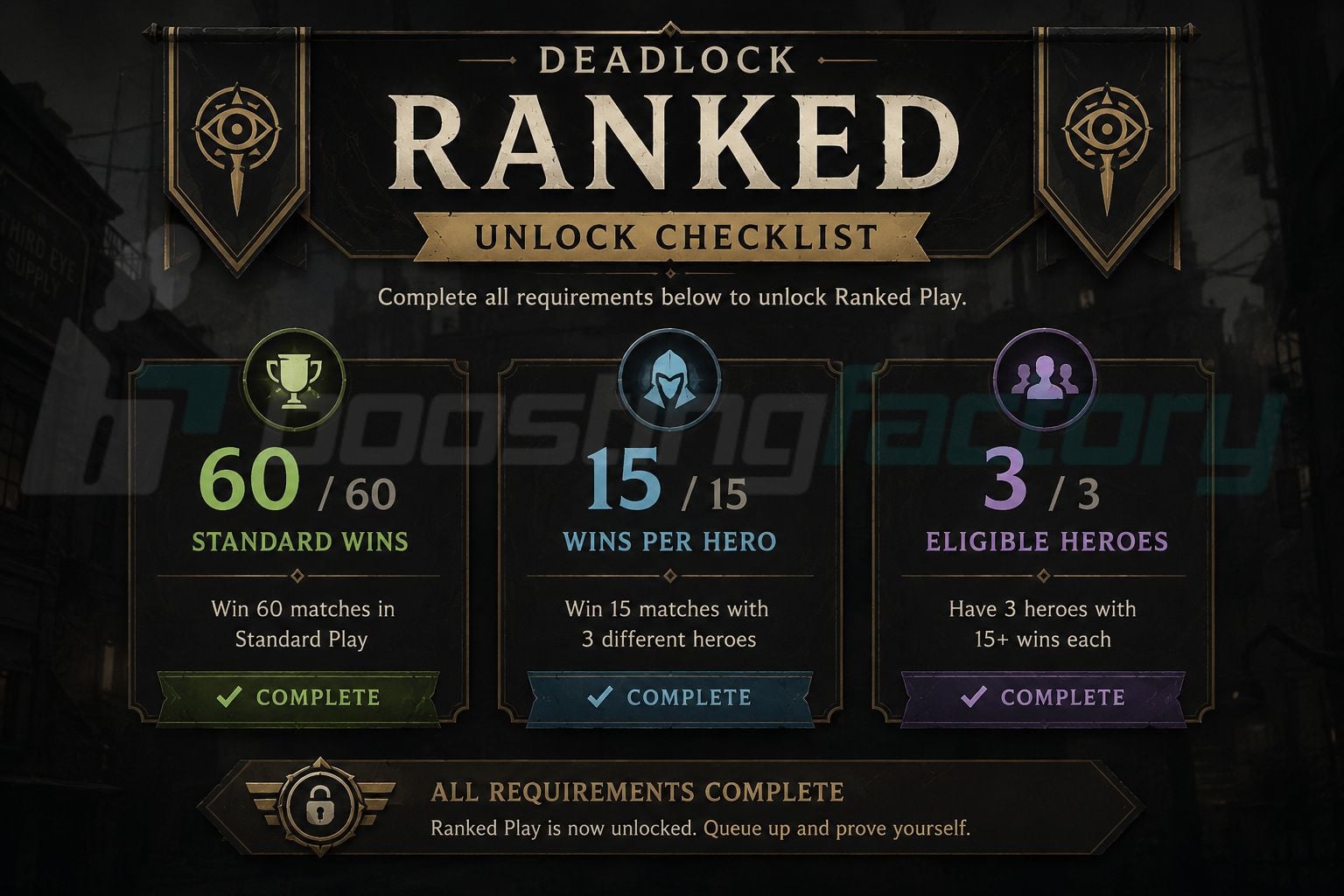
Deadlock Ranked Mode is not available immediately. Players must first prove that they understand the game and have a usable hero pool.- Earn at least 60 wins in Standard Mode.
- Earn at least 15 Standard wins with each hero you want to use in Ranked.
- Unlock at least three Ranked-eligible heroes.
- Have no active sanctions, low-priority penalties, or communication bans.
The hero requirement is also separate from your overall wins. A hero only becomes available in Ranked after you have won at least 15 Standard Mode games with that specific hero.
For example, having 60 total wins and two heroes with 15 wins each is not enough. You must have at least three heroes that meet the 15-win requirement before your Ranked roster is considered large enough.
How Deadlock Ranked Seasons Work
Ranked Mode now uses a seasonal structure. Players climb throughout each season, and the highest Rank they reach is permanently saved on their Rank history page.The first season begins with the release of the new Ranked system and ends on October 7, 2026.
At the end of a season, players will receive an item in the hideout that commemorates their highest achieved Rank.
Deadlock Calibration Matches Explained
Every player begins a new Ranked season with a calibration phase. You must complete eight calibration matches before receiving your starting Rank.Deadlock uses a soft reset rather than treating every player as completely new. Some history from your previous performance is retained and used to seed you into appropriate calibration matches.
This means that previous results still matter. However, everyone must complete the eight-game calibration process before returning to normal Ranked progression.
Calibration matches have two important restrictions:
- You cannot play calibration games in a party.
- The highest Rank you can receive after calibration is Oracle VI.
Even a highly rated player cannot calibrate directly into Phantom, Ascendant, or Eternus. Those Ranks must be reached through normal Ranked progression after calibration.
All Deadlock Ranks in Order
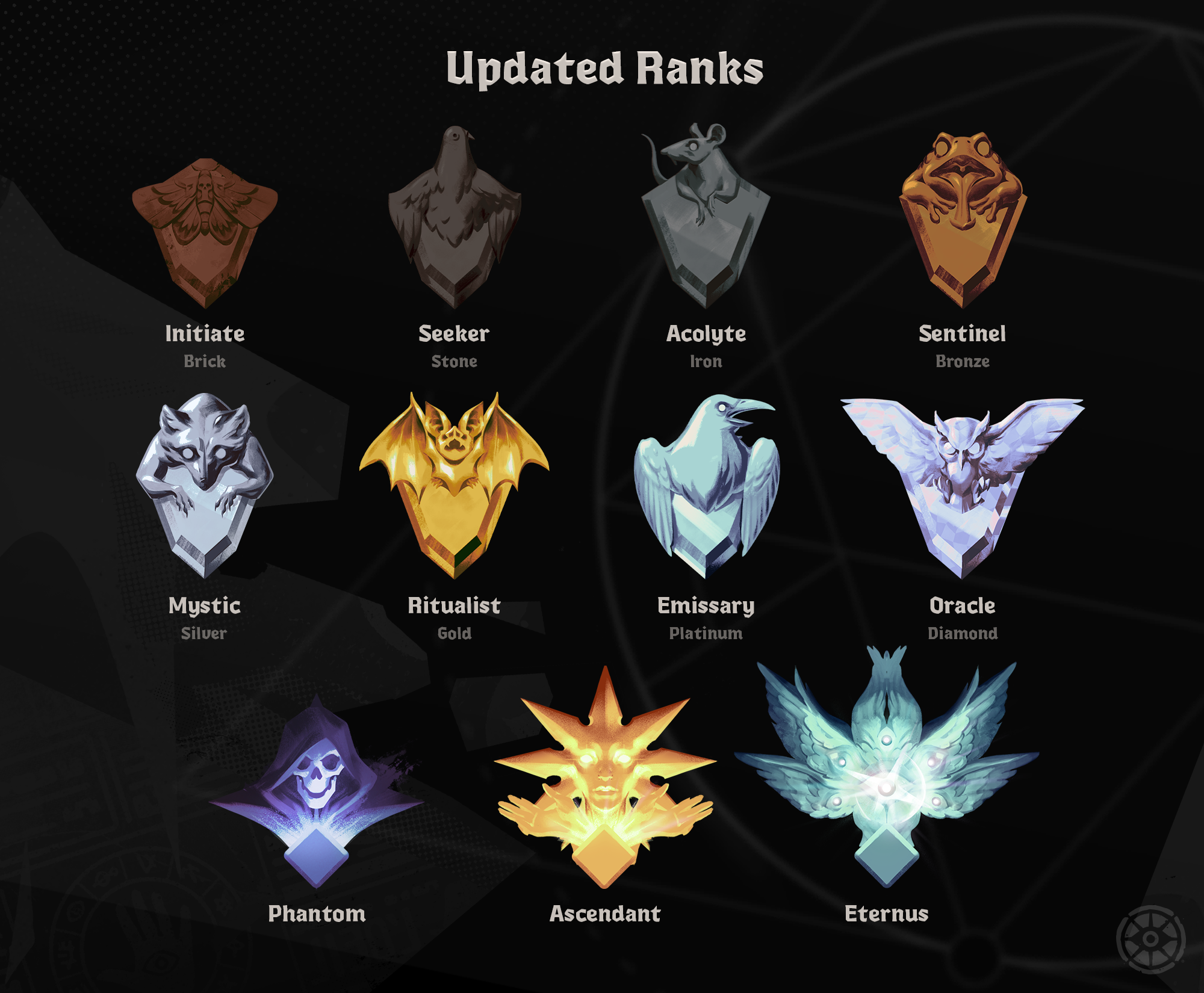
The new Deadlock Ranked system contains 11 competitive Ranks, plus Obscurus for players who have not finished calibration.Each competitive Rank contains six Subranks, numbered from I to VI. Subrank I is the lowest stage of a Rank, while Subrank VI is the highest.
| Order | Deadlock Rank | Subranks |
|---|---|---|
| Uncalibrated | Obscurus | Calibration status |
| 1 | Initiate | I to VI |
| 2 | Seeker | I to VI |
| 3 | Acolyte | I to VI |
| 4 | Sentinel | I to VI |
| 5 | Mystic | I to VI |
| 6 | Ritualist | I to VI |
| 7 | Emissary | I to VI |
| 8 | Oracle | I to VI |
| 9 | Phantom | I to VI |
| 10 | Ascendant | I to VI |
| 11 | Eternus | I to VI with dynamic thresholds |
How Deadlock Rank Points Work
A win or loss changes your score by around 250 Rank Points on average. The exact amount can vary depending on the result expected by the matchmaker and whether you are on a win streak.Most promotions require 1,000 Rank Points. However, moving from Subrank VI into the next full Rank requires 2,000 Rank Points.
| Progression | Points Required | Example |
|---|---|---|
| Normal Subrank promotion | 1,000 RP | Mystic II to Mystic III |
| Normal Subrank promotion | 1,000 RP | Mystic V to Mystic VI |
| Promotion into a new Rank | 2,000 RP | Mystic VI to Ritualist I |
How Eternus Rank Progression Works
Once you reach Eternus I, there is no fixed number of Rank Points required for each promotion.Instead, Eternus Subrank thresholds are updated every day. Players are separated into Subranks based on their position compared with the rest of the Eternus player pool.
This percentile system means an Eternus threshold can move even when your own Rank Points remain unchanged. Your position depends both on your results and on the performance of other high-ranked players.
Deadlock Rank Loss Protection
Deadlock includes Rank loss protection to prevent players from immediately dropping after reaching a new Subrank or full Rank.| Rank Position | Loss Protection | Example |
|---|---|---|
| Full Rank boundary | 5 games | Mystic I at 0 Rank Points |
| Subrank boundary | 2 games | Mystic III at 0 Rank Points |
At a normal Subrank boundary, the protection is shorter. For example, Mystic III at zero points receives two games of protection before a demotion to Mystic II can happen.
Can You Play Deadlock Ranked With Friends?
Deadlock Ranked currently supports solo and duo parties. Larger groups must play Standard Mode.During calibration, all players must queue solo. Duo parties become available after both players have completed their eight calibration matches.
Normal duo partners can be no more than one full Rank apart. For example, a Mystic player can queue with a Ritualist player, but not with an Emissary player.
Eternus uses stricter party rules. An Eternus player can only queue with another Eternus player, and the two players must be within three Subranks of each other.
| Party Example | Allowed? | Reason |
|---|---|---|
| Mystic and Ritualist | Yes | The players are one Rank apart |
| Mystic and Emissary | No | The Rank difference is too large |
| Eternus II and Eternus V | Yes | The players are three Subranks apart |
| Eternus II and Eternus VI | No | The players are more than three Subranks apart |
| Eternus and Ascendant | No | Eternus players can only queue together |
How Ranked Hero Selection Works
Deadlock still lets players select hero preferences before joining the matchmaking queue. The matchmaker then tries to give each player one of their preferred heroes while creating a balanced team composition.The new update adds a pre-game waiting area after the match has been formed. During this phase, players can review both teams' initial Ranks and make limited adjustments before the game begins.
You can switch from your assigned hero to another available hero, but several restrictions apply:
- The new hero must be unlocked for Ranked through 15 Standard wins.
- The hero cannot already be selected by another player.
- Each player can change heroes only once.
- Enemy hero changes are not shown live.
The feature is designed to improve your team's overall composition. It is not intended to be a full counter-pick system where both teams repeatedly react to each other's choices.
Pre-Game Lane Changes and Match Rules
The new waiting area also allows teammates to adjust their starting lanes. This gives the team time to fix an uncomfortable lane setup before the match begins.Once the pre-game phase ends, players cannot use the zipline to swap starting lanes. Any lane changes should therefore be agreed on before entering the live match.
Pausing is also disabled until two minutes after the game has fully started. Players should use the waiting area to finish hero, lane, and strategy discussions before play begins.
Deadlock Ranked Hero Bans
Ranked matches now include three banned heroes instead of two. The algorithm used to decide the bans has also been updated.The developers have not published every detail behind the banning algorithm. However, the extra ban should reduce how often the same high-priority heroes appear and create more variety between Ranked matches.
Deadlock Ranked Abandon Rules
Abandons now have different outcomes depending on when the player leaves, whether the leaver is in a party, and whether the remaining team completes the match.If a Player Abandons Before Five Minutes
When a player abandons before the five-minute mark, the match is marked as safe to leave and voided for most players.- The abandoning player receives a loss.
- Members of the abandoning player's party also receive a loss.
- The abandoning player receives leaver penalties.
- Everyone else has the match voided and may safely leave.
If a Player Abandons After Five Minutes
An abandon after five minutes does not immediately remove the possibility of earning a win.- The abandoning player receives leaver penalties.
- The abandoning player's party receives a loss.
- Other teammates have the match voided and may safely leave.
- Teammates who stay and win still receive a win.
- If the entire affected team leaves, the game ends and the opposing team receives a win.
| Situation | Leaver | Leaver's Party | Other Teammates | Opposing Team |
|---|---|---|---|---|
| Abandon before 5 minutes | Loss and penalty | Loss | Match voided | Match voided |
| Abandon after 5 minutes | Loss and penalty | Loss | Void, or win if they stay and win | Can continue and earn a win |
| Entire affected team leaves | Loss and penalty | Loss | Match ends | Win |
What Happens If Both Teams Have a Leaver?
If someone on the opposing team later abandons as well, that player and their party are penalized under the same rules.The remaining players on either team will not receive a loss. A team only receives a win if its remaining players stay, finish the match, and win.
Deadlock Ranked Penalties
You cannot enter Ranked Mode while your account has an active sanction. This includes low-priority status, communication bans, and other active matchmaking penalties.Leaver penalties begin with temporary queue timeouts. Repeated abandons can lead to an increasing number of required low-priority games.
Party members should also be careful when queueing together. If someone in your party abandons, the game can count as a loss for the entire party even when the other party member stays.
The New Deadlock Ranked Hub
The hideout now includes a dedicated Ranked Hub. It acts as the main location for information about current and previous seasons.The Ranked Hub includes:
- Current Ranked season information
- Past seasonal results
- Global leaderboards
- Your personal Rank history
- Your highest achieved seasonal Rank
- Seasonal commemorative items
At the end of each season, your highest achieved Rank remains permanently visible in your history. This records your best result even if you lost Rank Points before the season ended.
Updated Deadlock Leaderboard Requirements
The update also makes it harder to appear on the global and hero-specific leaderboards. Players must now complete more recent games to remain eligible.| Leaderboard | Previous Requirement | New Requirement |
|---|---|---|
| Global leaderboard | 50 games during the last 30 days | 75 games during the last 30 days |
| Hero leaderboard | 20 games on that hero during the last 30 days | 30 games on that hero during the last 30 days |
| Hero lifetime wins | No stated requirement | At least 100 lifetime wins on that hero |
What the Deadlock Ranked Update Means for You
For new players, the main priority is building a reliable hero pool. You should work toward 60 total Standard wins while earning at least 15 wins on three different heroes.Returning Ranked players must complete eight solo calibration matches. Your previous performance still helps seed those matches, but your new starting Rank cannot be higher than Oracle VI.
Need Help Climbing the New Deadlock Ranks?
The new Ranked system makes progression more transparent, but climbing still requires many wins. Most Subrank promotions cost 1,000 Rank Points, while moving into a new full Rank costs 2,000 points.Boosting Factory offers two services for different stages of your seasonal climb:
| Service | Best For | Goal |
|---|---|---|
| Deadlock Calibration Boost | Players starting a new Ranked season | Complete eight calibration matches with strong results |
| Deadlock Rank Boost | Players who have completed calibration | Climb from the current Rank or Subrank to a selected target |
The Deadlock Rank Boost is designed for normal progression after calibration. You select your current position and desired Rank, and a professional Deadlock player completes the required climb.
Frequently Asked Questions
How many wins do you need to unlock Deadlock Ranked?
You need at least 60 wins in Standard Mode before you can enter Deadlock Ranked.How many heroes do you need for Deadlock Ranked?
You need at least three eligible heroes. Each hero must have at least 15 wins in Standard Mode before you can use it in Ranked.How many Deadlock calibration matches are there?
Every player must complete eight calibration matches at the beginning of the Ranked season.Can you play Deadlock calibration matches with a friend?
No. You cannot be in a party during calibration matches. All eight calibration games must be played solo.What is the highest Deadlock calibration Rank?
The highest Rank you can receive after calibration is Oracle VI. Phantom, Ascendant, and Eternus must be reached after calibration.How many Rank Points do you get per Deadlock win?
A win or loss changes your rating by around 250 Rank Points on average. The exact amount may vary based on the matchmaker's expectations and win streaks.How many Rank Points are needed for a promotion?
Most Subrank promotions require 1,000 Rank Points. Moving from Subrank VI into the next full Rank requires 2,000 points.Can you duo in Deadlock Ranked?
Yes. Normal Ranked matches support solo and duo parties. Calibration matches are solo-only.How close do duo partners need to be in Rank?
Most duo partners must be no more than one full Rank apart. Eternus players can only queue with another Eternus player within three Subranks.Can you change heroes after entering a Ranked match?
Yes. You can change to another available Ranked-eligible hero during the pre-game waiting area. Each player can only switch heroes once.How many heroes are banned in Deadlock Ranked?
Three heroes are now banned in each Ranked game. The previous system banned two.Does an abandoned Deadlock match count as a loss?
It depends on who left, when they abandoned, and whether they were in your party. The leaver and their party normally receive a loss, while other teammates may have the match voided.What is Deadlock Rank loss protection?
Full Rank boundaries provide five games of loss protection. Normal Subrank boundaries provide two games of protection before you can be demoted.What is the difference between calibration and Rank Boosting?
Calibration Boosting covers the eight matches used to determine your seasonal starting Rank. Rank Boosting begins after calibration and helps you progress from your current Rank toward a selected target.
Eternus