
Summoner’s Journey may look like a normal League ranked ladder, but it follows its own placement, rank, and progression rules. Players must first unlock the system, complete five placement games, and receive an initial Emblem and division.
This LoL Classic Summoner’s Journey guide explains how placements work, every rank from Salt to Legend, and what happens as you climb.
Quick answer: Summoner’s Journey unlocks at Classic Level 10. You then complete five placement games, which determine your first Emblem and division. Salt is the lowest rank, while Legend is the highest.
What Is Summoner’s Journey in LoL Classic?
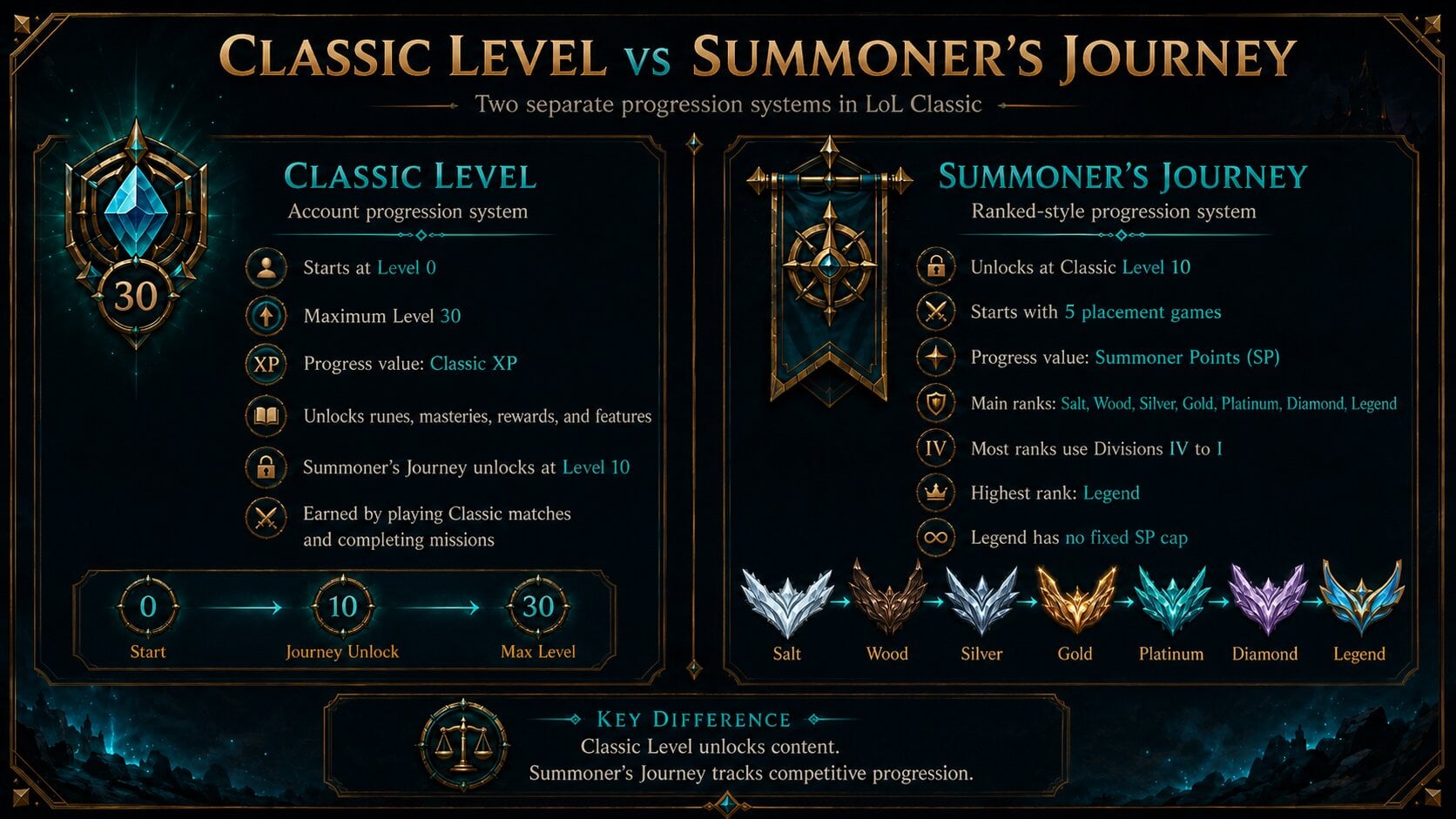
Summoner’s Journey is a progression system made specifically for League of Legends Classic. It gives players a long-term goal without turning Classic into the same type of ranked ladder used in modern League.The system unlocks once you reach Classic Level 10. After unlocking it, you complete five placement games before receiving your first Journey Emblem and division.
Summoner’s Journey uses two main parts:
- Emblems: The main ranks, such as Salt, Wood, Silver, and Legend
- Divisions: Smaller stages within most Emblems, running from Division IV to Division I
Your progress is measured with Summoner Points, usually shortened to SP. Classic XP and SP are separate, so increasing your Classic Level does not directly increase your Journey rank.
Riot designed Summoner’s Journey as an achievement system that players can climb while still playing Classic with friends. It is not meant to be a direct copy of modern Solo Queue.
How to Unlock Summoner’s Journey
Summoner’s Journey is not available when you first enter League Classic. You must make progress through the separate Classic Level system first.The unlock process works like this:- Begin at Classic Level 0
- Earn Classic XP by playing matches and completing missions
- Reach Classic Level 10
- Unlock Summoner’s Journey
- Complete five placement games
- Receive your first Emblem and division
Players still working toward the unlock can read our complete LoL Classic leveling guide or use our LoL Classic Level Boost to reach Level 10 faster.
Important: Reaching Level 10 only unlocks Summoner’s Journey. You will not receive a visible Journey rank until your five placement games are complete.
How LoL Classic Placement Games Work
Every player completes five placement games after unlocking Summoner’s Journey. These games determine both your starting Emblem and your starting division.You do not automatically begin at Salt. Strong placement results can give you a higher starting position, but Riot has not published a chart that connects each possible record to a guaranteed rank.
| Placement Stage | What Happens |
|---|---|
| Before placements | Summoner’s Journey is unlocked, but you do not yet have an assigned Emblem or division. |
| Matches 1 to 4 | Your placement progress continues, but your final starting rank is not yet confirmed. |
| Match 5 completed | The system assigns your initial Journey Emblem and division. |
| After placements | Your future Summoner Points move you through divisions and Emblems. |
Can You Place Higher Than Salt?
Yes. Salt is the lowest Summoner’s Journey Emblem, but it is not the automatic starting rank for every player.Your five placement games decide where you begin. Better placement results may place you into a higher Emblem or division, although the exact formula has not been made public.
What Rank Does a 5-0 Placement Give You?
There is no confirmed guaranteed rank for winning all five placement games. A strong result should help your initial placement, but players should not expect a specific Emblem until the final result appears in the client.The same rule applies to records such as 4-1, 3-2, or 2-3. These records may affect the result, but they do not provide a guaranteed public placement outcome.
All LoL Classic Summoner’s Journey Ranks
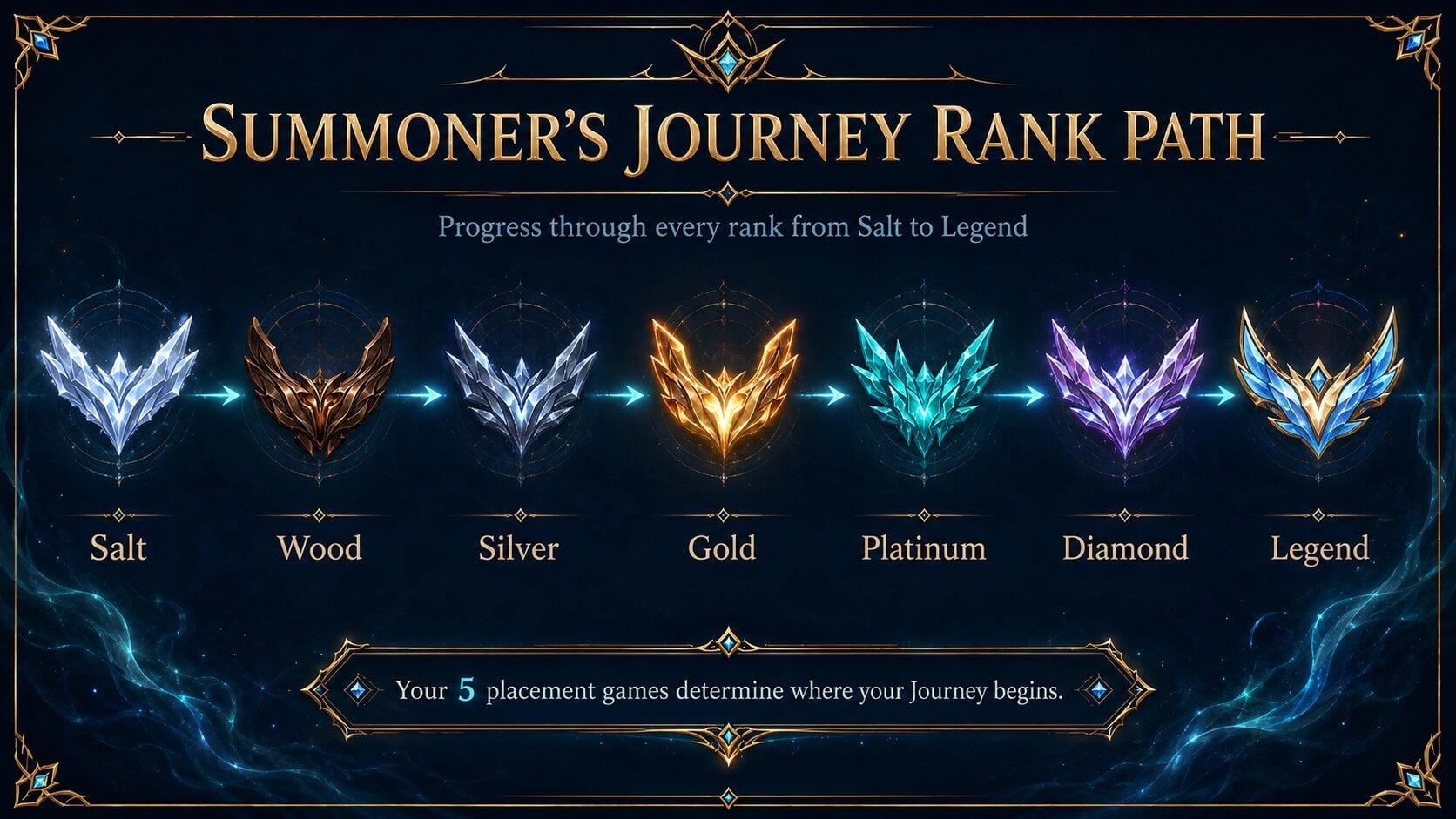
Summoner’s Journey contains seven main Emblems. The climb begins with Salt at the bottom and ends with Legend at the top.Most Emblems contain four divisions. Division IV is the lowest part of an Emblem, while Division I is the highest part before the next promotion.
| Order | Journey Emblem | Divisions | Position in the Journey |
|---|---|---|---|
| 1 | Salt | IV to I | Lowest Emblem |
| 2 | Wood | IV to I | Early progression |
| 3 | Silver | IV to I | Developing progression |
| 4 | Gold | IV to I | Middle of the Journey |
| 5 | Platinum | IV to I | Advanced progression |
| 6 | Diamond | IV to I | Final Emblem before Legend |
| 7 | Legend | No standard divisions | Highest Journey Emblem |
Salt → Wood → Silver → Gold → Platinum → Diamond → Legend
Salt
Salt is the lowest Summoner’s Journey Emblem. It contains Divisions IV, III, II, and I.Some players may receive a Salt placement after their first five games, but it is not the required starting rank for everyone. Players who place here can still progress through every later Emblem.
Wood
Wood is the second Journey Emblem. It sits above Salt and also contains four divisions from IV to I.Players may reach Wood through regular progression or receive it directly from their placement games. Moving through Wood brings you toward the more familiar Silver and Gold names.
Silver
Silver is the third Emblem in Summoner’s Journey. It marks the point where players have moved beyond the two lowest Classic-specific ranks.Like the earlier Emblems, Silver contains four divisions. Progress continues from Silver IV through Silver I before Gold becomes available.
Gold
Gold sits in the middle of the seven Journey Emblems. It represents meaningful progress through the system without yet reaching its highest stages.Players climbing through Gold should begin relying on a smaller champion pool and more stable role choices. Classic items, Runes, and Masteries can punish poor preparation more than modern League systems.
Platinum
Platinum is the fifth Journey Emblem and the beginning of the higher end of the system. It comes after Gold and before Diamond.Reaching Platinum shows that a player has progressed through most of the available Emblems. Continued improvement and consistent match quality become more important from this point.
Diamond
Diamond is the final standard Emblem before Legend. It contains Divisions IV through I.Players who reach Diamond are near the top of Summoner’s Journey. Progressing beyond Diamond leads into the exclusive Legend Emblem.
Legend
Legend is the highest rank in LoL Classic Summoner’s Journey. Riot expects only a single-digit percentage of players to reach it.Unlike other Emblems, Legend does not use the same protected Division IV floor. It also has no fixed maximum Summoner Point cap, so Legend players can continue collecting SP and competing for greater prestige.
How Summoner Points Work
Summoner Points are the progression value used by Summoner’s Journey. They are commonly shown as SP.After your five placement games, SP moves you through divisions and toward higher Emblems. It is separate from the Classic XP used to increase your Classic Account Level.
| Progression System | Progress Value | Main Purpose |
|---|---|---|
| Classic Level | Classic XP | Unlocks Runes, Masteries, rewards, and Summoner’s Journey |
| Summoner’s Journey | Summoner Points | Moves you through Journey divisions and Emblems |
Can You Derank in Summoner’s Journey?
Riot gives most Journey Emblems a protected floor at Division IV. Once you have reached an Emblem, Division IV is the lowest point you can fall to within that Emblem.This means a player who has reached Gold cannot fall below Gold IV into Silver. The same protection applies to Salt, Wood, Silver, Gold, Platinum, and Diamond.
Legend is the only exception. It does not use the same protected floor, so Legend status is not secured in the same way as the lower Emblems.
Rank protection: Division IV is the floor for every standard Journey Emblem. Legend is the only Emblem without this protection.
Summoner’s Journey vs Modern LoL Ranked
Summoner’s Journey uses ranks, divisions, placements, and progression points, but it is still separate from modern League Ranked.The two systems belong to different game experiences and use different rank names. Progress in one system does not replace progress in the other.
| Feature | Summoner’s Journey | Modern LoL Ranked |
|---|---|---|
| Game version | League of Legends Classic | Modern League of Legends |
| Unlock requirement | Classic Level 10 | Standard Ranked account requirements |
| Initial ranking | Five placement games | Ranked placement matches |
| Progress value | Summoner Points | League Points |
| Lowest rank | Salt | Iron |
| Highest rank | Legend | Challenger |
| Main purpose | Classic achievement and progression system | Modern competitive ranked ladder |
Your modern Ranked position also does not replace your five Summoner’s Journey placements. Classic uses its own progression path after the system is unlocked.
How to Climb Summoner’s Journey More Consistently
There is no guaranteed shortcut to a specific Journey Emblem. However, better preparation can improve the quality and consistency of your games.1. Take the Five Placement Games Seriously
Your placement games decide where your Journey begins. Use champions and roles you already understand instead of testing new picks during these matches.Play when you have enough time to focus. Avoid starting an important placement when you may need to leave or rush through the match.
2. Use a Small Champion Pool
Choose two or three dependable champions for your strongest roles. A smaller pool makes it easier to understand matchups, damage limits, item timings, and teamfight decisions.You can expand your champion choices later. During placements and important progression games, reliability is usually more useful than variety.
3. Prioritise Your Best Role
League Classic lets you order roles by preference. The system tries to give you your preferred position while avoiding your lowest choice when queue health allows it.Place your strongest role first and your weakest role last. Prepare at least one reliable champion for your second and third preferences in case you do not receive your first choice.
4. Prepare Runes and Masteries Before Queueing
Classic Runes and Masteries can strongly affect how a champion performs. Check your setup before entering champion select instead of relying on the default page.Create pages for your most common champions and roles. This reduces last-second mistakes and gives you more time to focus on the draft.
5. Play With a Reliable Duo
A dependable duo can improve communication, lane coordination, and objective control. It also gives you at least one teammate whose champion pool and playstyle you understand.Choose roles that work together naturally, such as jungle and mid or bottom and support. The goal should be consistent teamwork rather than forcing risky strategies.
6. Stop Playing When Your Performance Drops
Repeated losses can lead to rushed decisions and poor champion choices. Take a break when you notice frustration, slower reactions, or weak communication.Returning later with better focus is usually more productive than continuing a bad session. This is especially important during placements.
7. Learn the Classic Meta
Classic champions, items, Runes, and Masteries are different from their modern versions. A strong modern League build may not work the same way in Classic.Read ability details, check old item interactions, and understand your champion’s earlier strengths and weaknesses. Classic gameplay often rewards planning and resource management more than constant mobility.
Can Boosting Help You Climb Summoner’s Journey Faster?
Players who want help with placements or later Journey progression can use our LoL Classic Placement Boost and LoL Classic Division Boost.The service supports players who have not yet completed their placements and players who already have an assigned Emblem. You can choose your current position and desired target.
Professional boosters complete orders through normal League Classic matches. The service does not use bots, scripts, cheats, or SP exploits.
Climb Through Summoner’s Journey
Choose placement support or start from your current Emblem. Piloted and Duo progression options are available.
Buy Summoner’s Journey Boost
LoL Classic Summoner’s Journey FAQ
What is Summoner’s Journey?
Summoner’s Journey is League Classic’s rank-based progression system. It uses placement games, Emblems, divisions, and Summoner Points.What level unlocks Summoner’s Journey?
Summoner’s Journey unlocks at Classic Level 10. Reaching Level 10 requires 1,400 total Classic XP.How many Summoner’s Journey placement games are there?
You must complete five placement games. Your results determine your first Emblem and division.Does every player start at Salt?
No. Salt is the lowest available Emblem, but your placement games can assign a higher starting rank.What rank do you get for winning all five placements?
Riot has not published a guaranteed result for a 5-0 placement record. Your exact Emblem and division appear after the final placement game.What are all LoL Classic Summoner’s Journey ranks?
The ranks are Salt, Wood, Silver, Gold, Platinum, Diamond, and Legend.How many divisions does each Emblem have?
Salt, Wood, Silver, Gold, Platinum, and Diamond each contain Divisions IV through I. Legend does not use the same standard division structure.What is the highest LoL Classic rank?
Legend is the highest Summoner’s Journey Emblem. Riot expects only a single-digit percentage of players to reach it.What does SP mean in LoL Classic?
SP means Summoner Points. It is the value used to track Summoner’s Journey progression after your placements.Can you drop to a lower Emblem?
Division IV is a protected floor for every standard Emblem. Once you reach a new Emblem, you cannot fall below its Division IV into the previous Emblem.Can you lose Legend?
Legend is the exception to the protected Emblem floor. It is not protected in the same way as Salt through Diamond.Is Summoner’s Journey the same as LoL Ranked?
No. Summoner’s Journey is a separate League Classic progression system, while modern Ranked uses its own queues, LP, and ranks.Is Legend the same as Challenger?
No. Legend is the highest Summoner’s Journey Emblem. Challenger is the highest rank in modern League Ranked.Can you continue gaining SP after reaching Legend?
Yes. Legend has no fixed SP cap, so players can continue collecting Summoner Points after reaching it.Final Summary
LoL Classic Summoner’s Journey unlocks at Classic Level 10. Players then complete five placement games before receiving their first Emblem and division.The full rank order is Salt, Wood, Silver, Gold, Platinum, Diamond, and Legend. Most Emblems contain Divisions IV through I, while Legend stands at the top with an unlimited SP cap.
Players can complete the Journey themselves or use our LoL Classic Summoner’s Journey Boosting service for placements or later rank progression.

Grandmaster
Secure your LoL seasonal rewards, today.